
Putnam County Court Records After a Jail Arrest
An arrest in Putnam County opens a custody record, but it does not open the full court case on its own. The path runs in steps. An officer makes the arrest. The person is taken to the Putnam County Jail for booking and intake. A first appearance follows, where a judge reviews bond and detention. The State Attorney for the Seventh Judicial Circuit then screens the arrest and files the formal charges. Those charges open a case on the court docket. The court records after that arrest hold the charge list, the hearings, and the disposition. So the arrest starts the chain, and the court records track what the case becomes.
It helps to keep two sides apart. The booking side lives on the sheriff's jail roster. For the custody status, booking number, and bond shown at intake, use the jail inmate records page. For the booking photo tied to that arrest, see the jail roster mugshots page. The court record is a different file. It is built by the clerk and the prosecutor, and it shows the charges the state formally filed after the arrest. A booking charge can be amended, reduced, or dropped before it ever reaches that court record.
How to Find Putnam County Court Records After an Arrest
The charges and charge status show up in the county court case search, not on the jail roster. The roster carries the arrest and booking detail. The court file carries what the prosecutor filed. Putnam County runs its court case search through the Online Court Records Search, or OCRS, hosted by Civitek. The fastest path starts on the jail roster, where a charge row often lists the court case number already. Copy that number first. Then move to the court portal and pull the case.
- On the SmartWEB jail roster, capture the booking number, booking date, the arrest charge names, the statute numbers, and any court case number shown in the charge table.
- Open the Putnam County Online Court Records Search and choose Public for anonymous access.
- Search by the defendant name, or by the case number you copied from the roster charge row.
- Open the case and read the charge list, then check each charge's statute, level, and current status, and compare those court charges against the roster charges.
Before you open the portal, it helps to see the access screen. You can reach it through the Putnam County court records gateway.
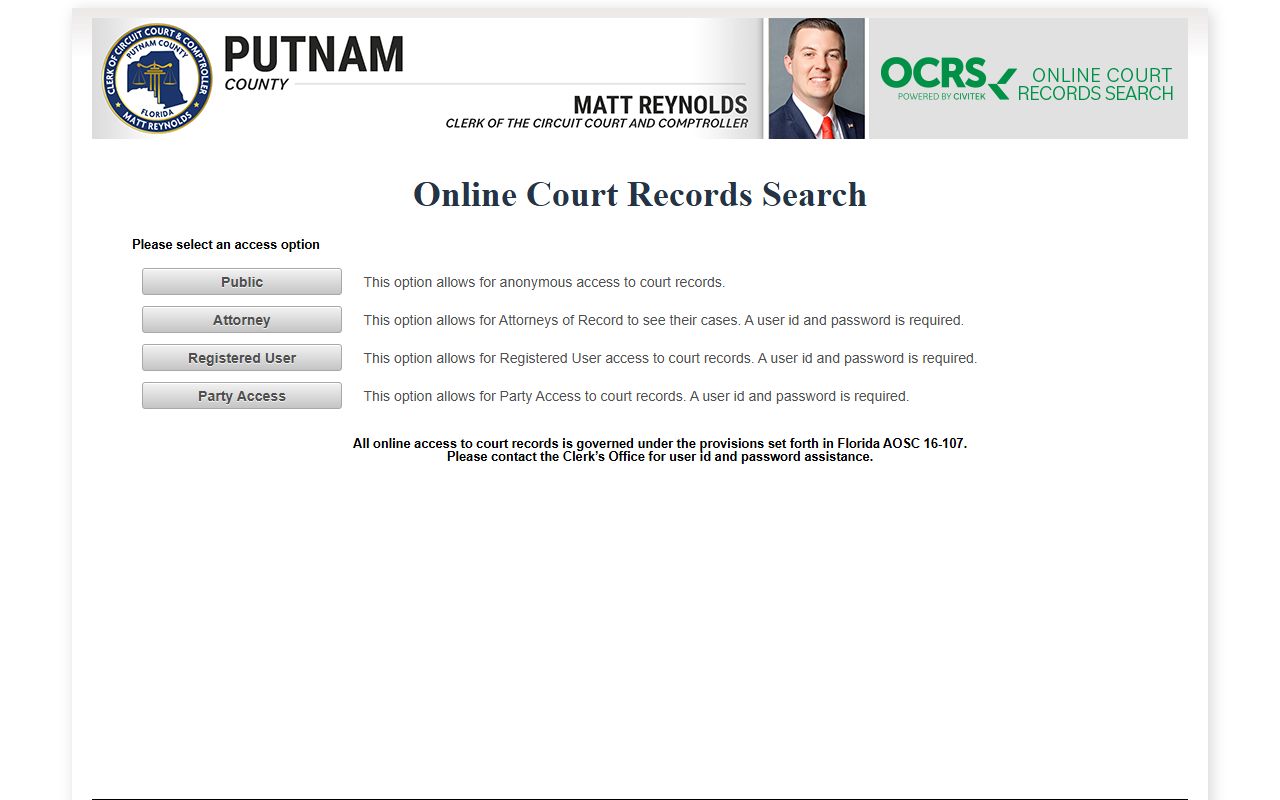
The gateway is the starting point for every public lookup of court records after an arrest in the county. If a case does not appear online, contact the Putnam County Clerk of the Circuit Court for older, sealed, restricted, or not-yet-indexed records. For statewide custody after a sentence, the court portal is the wrong tool. Check the Florida Department of Corrections inmate search instead, since FDC tracks sentenced state prisoners, not county court dockets. A broader statewide criminal history is a separate, usually fee-based search through state criminal-history services, and it is wider than a single county case.
How Putnam County Court Charges Get Filed: Complaint, Information, and Indictment
Walk the case forward from the arrest. Booking happens at the jail first. The court charge record does not begin until a charging document is filed. In Florida, formal charges may proceed by complaint, by information, or by indictment, and the choice depends on the case type and where it sits in the process. Each one opens the case in court. The State Attorney for the Seventh Judicial Circuit drives most of these decisions, and that office can file, decline, or change the charges that came out of the arrest.
| Complaint | Information | Indictment | |
|---|---|---|---|
| Filed By | Officer / Prosecutor | Prosecutor | Grand Jury |
| Common For | Misdemeanors | Many felonies | Serious felonies |
| Starts | The case | The case | The case |
Note: The roster charge entered at booking is not proof the same charge will be filed; the prosecutor reviews each arrest and can change, add, or drop counts.
Putnam County Court Charge Status and What It Means
Charges change as a case moves. A count can be amended, reduced, added, dropped, or dismissed before the case ends. This is why the booking charges on the jail roster often differ from the charges the prosecutor finally files. The court record shows the live status of each count, and the words below are the ones you will see most. Read them on the court docket, not on the roster, since the roster only reflects what was entered at intake.
| Status | What It Means |
|---|---|
| Pending | An active charge that has not been finally resolved; the case is still moving through court. |
| Amended / Reduced | The charge was changed after the first filing, often to a lower charge or a lesser offense. |
| Dismissed | The court or the prosecutor ended that charge, so it no longer proceeds. |
| Nolle Prosequi | The prosecutor chose not to go forward on the charge and formally dropped it. |
Role of the Seventh Judicial Circuit State Attorney
Putnam County does not have a county "district attorney." Its criminal cases are prosecuted by the Office of the State Attorney for the Seventh Judicial Circuit. That office reviews each arrest, files or declines the formal charges, amends counts, negotiates pleas, and represents the State of Florida in court. The jail roster shows the arrest charges. The state attorney and the court docket show what charges are actually pursued. That split is the heart of reading court records after an arrest, because the two lists can differ in real cases.
The circuit covers Putnam County along with nearby counties, and the local prosecutor contact point for Putnam matters is the Palatka office. You can view it through the Seventh Judicial Circuit State Attorney Palatka office page.
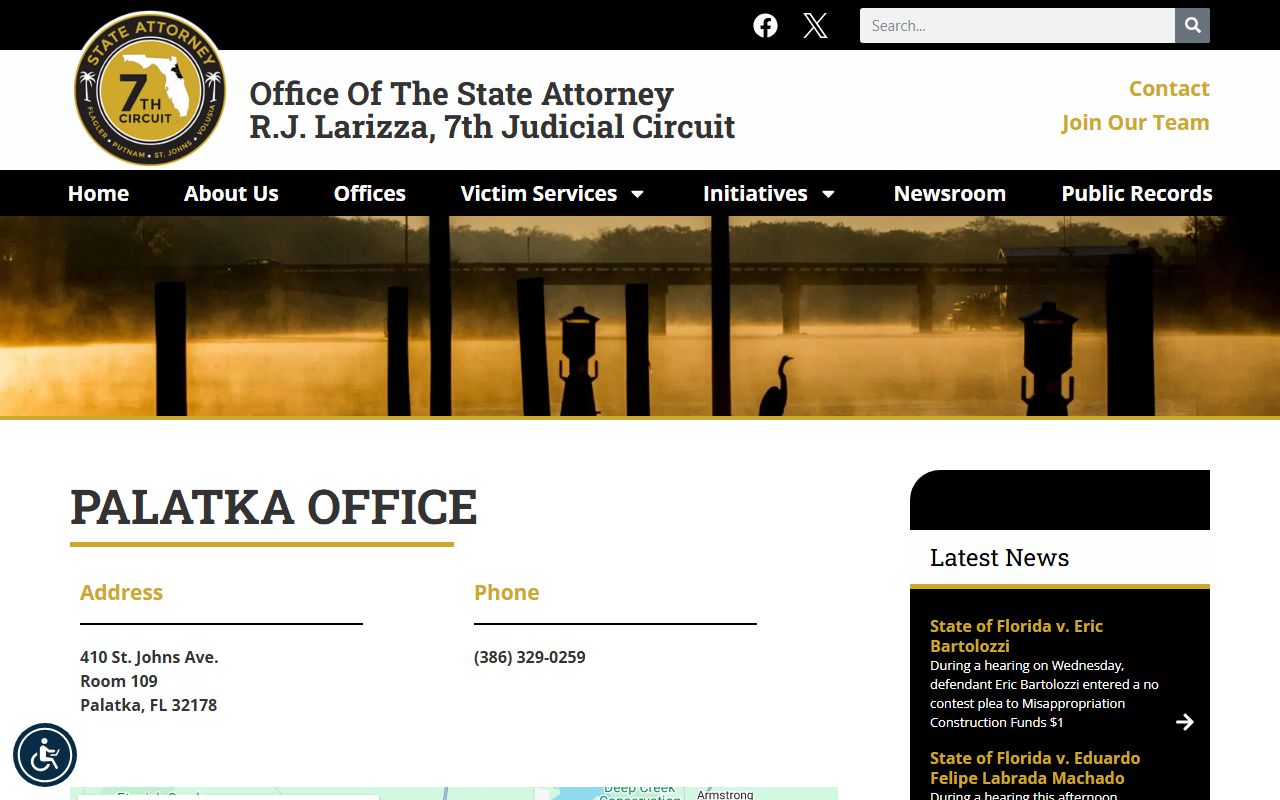
That office is where charging decisions for local arrests are made and where victim and witness questions are routed. For general circuit information, the State Attorney for the Seventh Judicial Circuit site and its contact page list the four-county reach and office details. A roster charge row may already show a court case number, which links the jail booking to the clerk's portal. If no case appears, it may not be indexed yet, it may be filed under a different number or name, or it may be restricted.
Bond and Release After a Putnam County Arrest
After booking, release usually turns on bond. A booked charge can carry a set bond amount, but the first appearance and any later judicial review can change the release terms. Florida law defines bail and bond and governs pretrial release and detention, mainly through Florida Statutes section 903.011 and Florida Statutes section 907.041. The jail roster is a snapshot of what the jail entered at intake. It is not the full court order history, so the court record stays the better source for the current release terms.
| Bond Type | How It Works |
|---|---|
| Cash Bond | Money is paid to secure release, subject to court rules and any fees. |
| Surety Bond | A licensed bail agent posts the bond for a fee; Florida still permits commercial bail bonding. |
| PR / Own Recognizance | The court releases the person on conditions, with no cash or surety bond required. |
| No-Bond Hold | The person cannot be released on that charge unless a court later sets or changes the terms. |
Some bookings show "NO BOND" in both the top bond field and the charge rows. Serious charges, violation cases, failures to appear, and outside holds can all read no bond. A hold or detainer from another county, the state, a federal agency, immigration, or probation can block release even when local bond is paid. Posting bond only addresses release; it does not dismiss the case. Court dates stay active, and a missed date can trigger a warrant and a fresh booking.
Note: Official Putnam County pages reviewed did not publish a detailed bond-posting fee table or bond-desk hours, so call the jail to confirm the current amount and whether any hold applies.
Putnam County Warrants That Lead to an Arrest
A warrant can turn into a new jail booking. When a person is arrested on a warrant, the roster may show a failure-to-appear or warrant-related charge, and that charge can read no bond. The warrant types that matter here are the arrest warrant, which authorizes arrest on a criminal matter, and the bench warrant, which a judge often issues after a missed court date. A search warrant authorizes a search and does not always lead to a booking. A fugitive or out-of-county warrant means another jurisdiction wants the person held or moved.
Putnam County did not have a confirmed standalone online warrant search in the official sources reviewed, so do not assume one exists. To check on a warrant, the fallback channels are the sheriff's main phone line and the Putnam County Sheriff's public records page. For court-issued bench warrants tied to a case, the Clerk of the Circuit Court is the right office. A roster search alone is not enough, since a person can have an open warrant without being in jail yet. For a failure-to-appear warrant, the underlying court case has to be addressed before the warrant clears.
Charges vs. Convictions in the Court Record
Being arrested and charged is not the same as being convicted. A charge is an accusation. A conviction is a finding of guilt by verdict or by plea. The court records after an arrest can show charges that never become convictions, because the case may be dismissed, dropped, or reduced. Read the charge status before you draw any conclusion from a name in the system.
| Charge | Conviction | |
|---|---|---|
| Stage | Accusation | Verdict or plea |
| Burden of Proof | Probable cause | Beyond reasonable doubt |
| Public Record | Yes | Yes |
Note: A booking is not a conviction; the disposition field on the court docket, not the jail roster, tells you how a charge actually ended.
Sealed vs. Expunged Arrest Records
After a dismissal or an eligible outcome, a person may move to clear the arrest record from ordinary public view. Florida draws a line between sealing and expunction. A sealed record is hidden from the general public but still kept, with limited access by certain agencies. An expunged record is treated as if it had been removed from ordinary access, and far fewer parties can reach it. Court-ordered expunction in Florida runs through Florida Statutes section 943.0585, which sets out who qualifies and how the process works.
| Sealed | Expunged | |
|---|---|---|
| Visibility | Hidden from public | Destroyed / treated as never existed |
| Law Enforcement | Limited access | Very limited |
| Eligibility | Set by Florida law; often after a qualifying disposition with no prior disqualifying record | Set by Florida law; typically for dismissed or eligible charges, narrower than sealing |
Eligibility depends on the charge, the outcome, and the person's prior record, so the statute and the court are the right authority before assuming a record can be cleared. Florida criminal-justice information and fingerprint reporting run under Florida Statutes section 943.051, which is why an arrest can echo across state systems until a court orders sealing or expunction.
Putnam County Court Records Access Options
The Putnam County Online Court Records Search opens with four access buttons, and the right one depends on who you are. Public access is anonymous and is the option most people use to read court records after an arrest. The other three are tied to specific roles, and each needs a user ID and password. If you need a login, the clerk's office handles that setup, not the portal screen itself.
- Public: anonymous access to the public court records search.
- Attorney: for attorneys of record; a user ID and password are required.
- Registered User: registered access with a user ID and password.
- Party Access: access for parties to a case, also with a login.
The portal posts a clear notice that all online access to court records is governed under Florida AOSC 16-107. For help getting a user ID and password, contact the Putnam County Clerk of the Circuit Court. Records held by the sheriff and records held by the clerk are separate, so request a missing record from the office that actually keeps it. Florida's public-records inspection rules sit in Florida Statutes section 119.07, which governs how agencies respond to a request.
Background Check Considerations
A casual name search of court records after an arrest is not the same as a formal background check. A formal, FCRA-compliant background check is run by a licensed provider under federal rules, with consent and notice steps. A quick public lookup of a county docket has no such protections and can be incomplete or out of date. For any decision that the law regulates, use a proper screening service rather than a raw docket search.
Important: This website is not a consumer reporting agency under the FCRA, and its information may not be used for credit, employment, housing, insurance, or tenant screening.
Restricted Court Records After an Arrest in Putnam County
Not every court record after an arrest is open to the public. Florida public-records law favors access to agency records, but it carves out exemptions. Juvenile arrest information, sealed or expunged cases, victim-sensitive details, and active criminal-investigation material may be withheld or redacted. The county court portal also does not publish full investigative reports or complete dockets in every view. The exemptions sit in Florida Statutes section 119.07 and related Florida public-records provisions.
When a record is restricted, the public portal may simply not show it. That is not always proof a case does not exist. The record may be sealed, filed under a different name or number, or not yet indexed. For older or restricted court matters, the Clerk of the Circuit Court is the office that can confirm what is releasable. For jail booking records, incident reports, or photos that are not online, the sheriff's public records channel is the correct fallback, since the sheriff and the clerk hold different parts of the story.
Note: A name that does not appear in the public court search may be restricted or simply unindexed, so confirm with the clerk before treating an absence as a clear record.